The Impact of AI on Education: The Global Revolution in Learning
The educational landscape is undergoing a rapid, irreversible shift driven by Artificial Intelligence (AI), fundamentally redefining teaching, learning, and academic institution management globally. AI presents both challenges and opportunities, with its deep and quick transformation of education being the central question. The article focuses on AI's reshaping of educational paradigms worldwide, with a special emphasis on India.
The Dawn of Personalized Learning with AI
AI's core transformative power lies in tailoring learning experiences to individual student needs, moving from a one-size-fits-all model to highly individualized instruction.
Adaptive Learning Paths & Content Curation: AI platforms analyze student performance to identify strengths, weaknesses, learning styles, and engagement patterns. This data customizes curricula and resources, ensuring appropriate challenge and pace. Examples include Khan Academy's Khanmigo and Duolingo.
Intelligent Tutoring Systems (ITS): These AI tutors act as virtual mentors, providing 24/7 feedback, answering questions, and guiding students through complex topics. They identify learning gaps early and offer targeted interventions.
Key benefits of personalized learning:
Increased student engagement and motivation.
Improved retention and deeper comprehension.
Reduced learning gaps through proactive challenge addressing.
Enhanced self-paced learning.
Greater accessibility for diverse needs.
In India, ed-tech companies like BYJU'S use AI for personalized learning modules.
 The AI-Powered Personalized Learning Cycle
Streamlining Education: AI in Administration & Operations
AI enhances efficiency across educational institutions, automating mundane tasks.
Automated Grading & Feedback: AI tools expedite assessments, offering quicker, more objective evaluations and timely feedback to students.
Predictive Analytics for Student Success: AI analyzes historical data to identify at-risk students, forecast enrollment trends, optimize resource allocation, and streamline admissions. Examples include Georgia State University's "Pounce" and NYU's "BobChat."
Administrative Task | Traditional Approach | AI-Powered Approach |
Grading & Feedback | Manual, time-consuming, subjective | Automated, objective, instant |
Student Inquiries | Staff-dependent, limited hours | Chatbots (24/7), instant responses |
Enrollment Forecasts | Historical data, manual analysis | Predictive analytics, high accuracy |
Resource Allocation | Intuitive, often reactive | Optimized based on real-time data |
Record Keeping | Manual entry, prone to errors | Automated, secure, accurate |
Table: Significant time and resource savings in administrative tasks.
 Efficiency gains in administrative tasks with AI.
Enhancing Content Creation & Accessibility
AI is changing how educational content is created and made accessible.
AI-Generated Learning Resources: AI tools help educators rapidly generate quizzes, summaries, practice problems, and lesson plans, allowing teachers to focus on instructional design and student interaction.
Breaking Language Barriers & Ensuring Accessibility:
Real-time translation: AI translates spoken or written materials instantly.
Captioning and transcription: Automated captioning aids hearing-impaired learners and improves comprehension.
Text-to-speech tools: Convert written text to audio for visually impaired students and those with reading difficulties.
India's Bhashini project and Anuvadini AI are government initiatives leveraging AI for translation across Indian languages. Google Translate also supports vernacular languages.
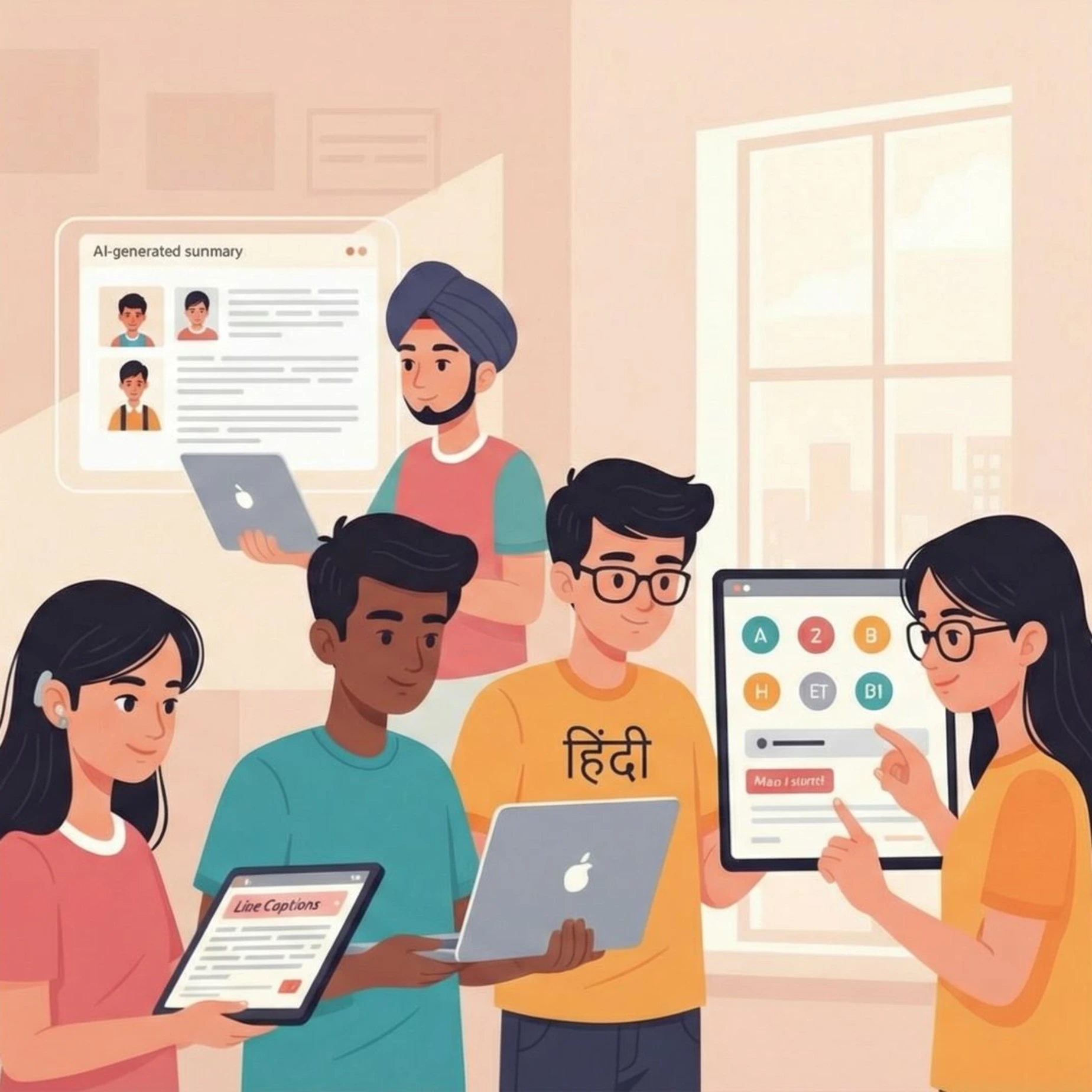
 A diverse group of students engaging with AI-generated content in multiple languages, highlighting accessibility.
Navigating the Challenges & Ethical Crossroads
AI integration in education faces critical challenges and ethical considerations.
Data Privacy & Security Concerns: Robust safeguards are needed for sensitive student data, adhering to regulations like GDPR and India's data protection laws. Transparency in data collection and usage is paramount.
Algorithmic Bias & Equity: AI algorithms can perpetuate or amplify societal biases present in training data, leading to unfair assessments. Fair, inclusive algorithm design and continuous auditing for bias are crucial.
The Role of the Human Educator: AI is an augmentation tool, not a replacement for human teachers. Teachers' roles are evolving to focus on fostering critical thinking, creativity, emotional intelligence, and complex problem-solving.
Ethical guidelines and best practices for AI implementation:
Transparency and Explainability.
Fairness and Justice.
Data Privacy and Security.
Human Oversight.
Augmentation, Not Replacement.
Promote Critical Thinking.
Accessibility.
Academic Integrity.
 A concept graphic illustrating a balancing scale between "Innovation" and "Ethics & Privacy" in AI.
The Indian Education Landscape: Embracing AI for the Future
India is uniquely positioned to leverage AI for educational advancement.
Government Initiatives & Policy (e.g., NEP 2020): The National Education Policy 2020 emphasizes technology integration, including AI, advocating for AI literacy, ethical AI use, and equitable access. Learn more about NEP 2020 and Digital Education.
Ed-Tech Boom & AI Adoption in India: India's Ed-Tech sector is booming, with AI at its core, projected to reach USD 29 billion by 2030. Startups and established players like BYJU'S, Unacademy, Vedantu, and others are pioneering AI-driven solutions. Investment is resurging, particularly in workforce skilling, language learning, and vernacular education.
Skilling for Tomorrow: Preparing the Indian Workforce: AI integration necessitates AI literacy and future-ready skills. India is incorporating AI into curricula and offering specialized training to equip the workforce for an AI-driven economy. Examples include AI-powered learning tools in Belagavi, AI-enabled classroom monitoring in Pimpri Chinchwad, and startups like Verzeo and Skill-Lync bridging the aspiration gap in smaller cities. New IITs are decentralizing AI education access.
 Infographic comparing "Global vs. Indian AI in Education: Key Trends & Opportunities."
The Future Outlook: What’s Next for AI in Education?
Exciting advancements promise to redefine learning further.
Immersive Learning Experiences (VR/AR & AI): The combination of AI with VR/AR will unlock engaging and interactive learning, such as virtual field trips with AI-powered historical figures or VR surgical simulations with AI feedback. Google Expeditions offers examples. Explore Immersive Learning with VR/AR/AI.
AI as a Research Partner: AI's data processing capabilities will accelerate educational research, uncovering insights into learning methodologies and effective teaching strategies.
Futuristic applications and predictions:
Hyper-personalized AI companions for lifelong learning.
Emotionally intelligent AI for empathetic support.
AI-powered dynamic curriculum design.
Decentralized AI learning networks.
AI for early childhood development.
A futuristic classroom with students interacting with holographic projections and VR headsets.
Frequently Asked Questions
Q: How is AI primarily transforming education for students?
A: Through personalized learning, adaptive content, and intelligent tutoring systems for more engaging and effective learning.
Q: What are the main challenges of implementing AI in educational institutions, especially in India?
A: Data privacy, algorithmic bias, infrastructure limitations, lack of digital literacy, and ensuring equitable access.
Q: Will AI replace human teachers in the classroom?
A: No, AI will augment teachers, automating tasks and providing insights, allowing them to focus on mentorship and socio-emotional development.
Q: How can Indian schools and colleges best leverage AI technology?
A: By integrating personalized learning, using AI for administration, adopting AI tools for content and accessibility, and investing in educator training, aligning with NEP 2020.
Q: What ethical considerations are crucial when using AI in education?
A: Safeguarding data privacy, preventing bias, ensuring equitable access, maintaining transparency, and preserving the human element.
Summary
Artificial Intelligence represents a profound paradigm shift in education, promising more personalized, efficient, and accessible learning globally. For India, AI offers a significant opportunity to bridge divides and unlock human capital potential. The future of human ingenuity and AI in education is bright, promising a richer, more equitable, and engaging learning journey. Staying informed and adapting is key.
Share your thoughts on AI's future in education and explore other resources on emerging technologies, including Future of EdTech.